Below is a presentation which Gary Mathes would present concerning church revitalization. Over the next few weeks we’ll feature posts which focus on this topic. I’ve asked John Vernon to help with this, and he suggested this would be a good starting point. It’s important to have this basic understanding before starting the conversation about revitalization – otherwise those involved will not understand where the church is in its life cycle nor why it’s time to get started with the revitalization process. The link directly below should also provide you a pdf of this document. As always, please feel free to leave comments or ask questions.
Church Life Cycle Basics
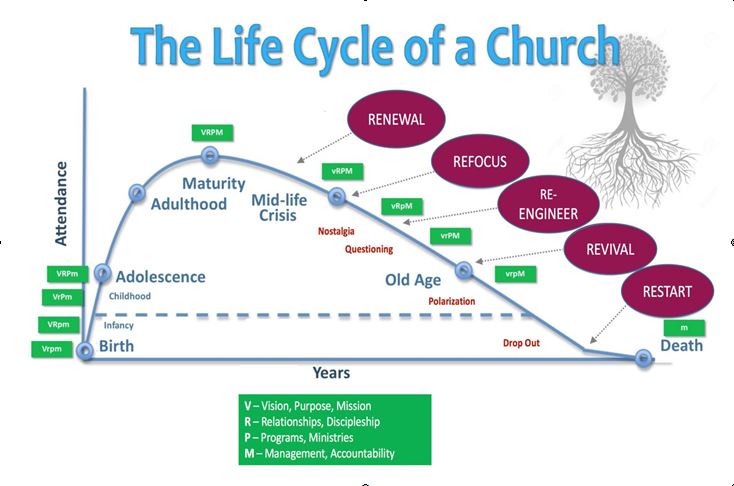
Birth
Primary Focus: Vision
Dream – Gives Birth to an organization
- The Founder’s Dream: Maintenance or Mission? Defensive or Offensive? Reactive or Intentional?
Infancy
Primary Focus: Vision and Relationships
Beliefs – Provides a values or doctrinal agreement for organizational skills
- Doctrinal Stance, Core Values, and Distinctiveness of Founder/Church
Adolescence
Primary Focus: Vision, Relationships and Programs
Goals – Extend the organization’s shared dream and beliefs
- Survivalistic versus evangelistic
- Risk Taking – willingness to take on debt
Adulthood
Primary Focus: Vision, Relationships and Programs
Structure – Organize the organization for pursuing its goals and advancing its dream
- Form Follows Function – Structure is determined by the goal
- The Dream stands on the structure
Maturity
Primary Focus: Vision, Relationships, Programs and Management
Ministry – Shows the congregation reaching out to others, developing its members, and living out its dream in Christian love
“The length of a congregation’s ministry is virtually endless, but when the ministry loses its focus on extending and expanding God’s Kingdom an organizational plateau occurs.”
Mid-Life Crisis
Primary Focus: Relationships, Programs and Management. Vision diminishes
Nostalgia – Reflects a wistful longing for a comfortable past — real or imagined — but the past tends to be more positive in memory than it was in reality
- Homesickness
- Lull before the storm
- “Things ain’t what they used to be and probably never was.” Will Rogers
Primary Focus: Relationships, Management. Relationships are diminishing, no future vision
Questioning – Marks the point of no return for the congregation, organizationally speaking
- Questioning is the now or never point of congregational health. Health or death are the choices.
- What happens when the prayer warriors walk away from the church?
Old Age
Primary Focus: Programs that used to work become the renewed focus, Management. Relationships begin to wane, some are strained, no future vision
Polarization – Creates an organizational climate in which members mistake one another for the enemy and fall into conflict
- Conflict is now open and may even grow nasty.
- Energies will tend to focus on conflict rather than ministry – people stop being saved!
Primary Focus: Survival and managing what is left is the only focus.
Dropouts – Result when the dream of effective ministry in this organization dies, and members retreat into inactivity
Revitalization strategies
Renewal: Renewal is for churches that have slowed in their growth or become stagnant. This church needs the encouragement of setting new challenges by embracing new opportunities to expand their gospel witness into their target area.
- The Renewal strategy works to help churches dream new dreams and accomplish new goals born out of a renewed vision of growing the kingdom of God.
Refocus: Refocusing is necessary when a church has stalled on a plateau or is experiencing decline after a phase of recent or initial expansion. The church begins to experience a high turn-over of lay leaders; with shorter duration of service. The congregation’s morale and momentum level drops as members begin to reflect on the days when things were good and the church was growing. This new normal is the first sign of a church becoming unhealthy.
- The Refocusing strategy works to help churches walk through a process of self- assessment and redefining its purpose & vision resulting in new growth & ministry goals.
Watershed question: Do you believe that your best years are behind you, or do you believe that your best years are yet before you?
Re-engineering: This third level of church revitalization needs to occur when a church is unable to prevent a pattern of decline and the leaders and members begin to question their strategy, goals and their ability to turn the tide and see growth again. Often the church has failed to change in order to stay healthy and relevant in reaching its community.
- The Re-engineering strategy works to help churches understand the need for and how to re-think, retool, reform, and reinvigorate itself to be more effective in accomplishing its God-given mission.
Revival: This level of Church Revitalization is necessary for churches that have lost their hope and have begun to polarize and cast blame on leadership or other members. Disillusionment sets in and the church begins to see a greater exodus of members. It has lost its’ spiritual dynamic and is unhealthy.
- The Revival strategy works to help churches identify where it has lost its spiritual vitality and/or congregational sin and calls the people of God to repent and make changes in order to repair relationships and realign itself with the purposes and plan of God.
Restarting: The final level of church revitalization is the hardest and often only happens once the church’s remaining members have made every effort to maintain a viable ministry with no success. The church no longer has the energy or resources to continue functioning as a viable congregation.
- The Restarting Strategy (Legacy strategy) helps a dying church to pass on a wonderful legacy by
- allowing a stronger and healthy church come and begin a new work in its place
- working with MBC & NAMB to send a church planter to restart a new church,
- merging with another church to make one stronger church,
- sell the property and passing on the assets for future church plants or revitalization efforts.
“The Gospel of Christ’s Kingdom hasn’t changed. We have only to dream it again.” – Robert Dale
 Missouri Baptist DOM Fellowship